Showing posts with label atheist. Show all posts

Tuesday, July 24, 2007

I respond

OpusHallelujahThe latest thing going around the atheistosphere is a list of questions on where atheists get their beliefs. This list helps define what atheism is to the individual atheist.

Funnily enough, and despite there being no dogma, there is a great deal of unanimity in the responses. In fact, far more unanimity than there seems to be within identical churches or from one xian to another. Dare I say it? My guess would be that our lack of dogma allows for simplicity...

So, here goes: My Answers in Atheism -
  • Why do you not believe in God? From a rational standpoint, it doesn't make sense to believe in the impossible; and we have found no irrefutable evidence of one - only fanciful stories about him.
  • Where do your morals come from? Simply from knowing that to be good, kind and ethical makes life easier for self and others.
  • What is the meaning of life? Life has no purpose. But propagation of the species does. What we do with the time we are alive is more important to others, since we have no afterlife to look forward to.
  • Is atheism a religion? No. No. And absolutely not!
  • If you don’t pray, what do you do during troubling times? Living the Serenity Prayer makes the most sense: Can it be fixed? Then fix it. If it can't be fixed? Accept it with maturity.
  • Should atheists be trying to convince others to stop believing in God? Yes. Encouraging people, actively or passively, to believe in a fantasy hinders their maturity.
  • Weren’t some of the worst atrocities in the 20th century committed by atheists? No. They committed the atrocities for political reasons: to gain power and remove threats to it. The "leaders" were only incidentally atheists; their actions weren't to make more atheists. Coincidentally, religion has commited attrocities for religio-political reasons: to consolidate power, to maintain power and to remove threats to it - and to make more believers through terror.
  • How could billions of people be wrong when it comes to belief in God? Because they were infected with the virus by their parents, starting in infancy. Religion is regional, tribal, and generational.
  • Why does the universe exist? The more elegant question is: why does the universe allow man to exist?
  • How did life originate? We don't know yet. But it's being investigated both vigorously and rigorously.
  • Is all religion harmful? Yes. It holds a false promise of an afterlife. It has an authoritarian power over the people who follow it. It uses their money to glorify individuals (Pope! Robertson! Dobson!) and does little for poverty, disease and quality secular education. It keeps adults in a child-like state.
  • What’s so bad about religious moderates? Because they stand as a bulwark protecting extremism by protecting and enabling the extremists. Both christianity and islam lean toward terroristic words and actions.
  • Is there anything redeeming about religion? I can't think of anything.
  • What if you’re wrong about God (and He does exist)? I'll take my chances, thanks. But I'm not worried.
  • Shouldn’t all religious beliefs be respected? Not really. Why should it?
  • Are atheists smarter than theists? Not necessarily smarter; but the fact is, the more education you have, the less you believe in god and the less you need faith. Atheism is not for the weak.
  • How do you deal with the historical Jesus if you don’t believe in his divinity? In my opinion, there was no biblical Jesus; the bible passes off second-, third- and fourth-hand narrative as "eyewitness testimony". Trust me, in a court of law, Jesus would have no "corpus" to be "habeas-ed"! It's all circumstantial evidence. And borrowed from earlier myths...
  • Would the world be better off without any religion? Yes. Everyone would be rated on their mature judgment and critical-thinking skills. And the money would be put to much better use.
  • What happens when we die? The human body is a "wet-cell battery". When the electrical power dies, the body dies and consciousness winks out like a television screen that's been turned off. This concept is too scary for children and childlike adults.
So, that's one atheist's perspective. Feel free to take the questions and answer them yourselves.

Tuesday, April 24, 2007

It's time for an intervention

This is a follow-up to Karl Marx's "...It is the opium of the people..."

syringe_americaWhen Religion is an Addiction

I remember hearing popular psychological speaker and writer John Bradshaw say that the “high” one gets from being righteous was similar to the high of cocaine. As both a former monk and addict, he knew the feelings personally.

As the religious right pushes its anti-gay, anti-women’s reproductive rights, anti-science, pro-profit agenda nationally and in state capitals across the nation and wins, that high is a sweet fix for the addicted. It gives them a comforting feeling of relief that they’re really right, okay, worthwhile, and acceptable.

...Like all fixes, though, it doesn’t last. So, the addict is driven to seek another and another – another issue, another evil, another paranoiac threat to defeat. It can’t ever end. Like the need for heavier doses, the causes have to become bigger and more evil in the addict’s mind to provide the fix.

This mind-altering fix of righteousness covers their paranoid shame-based feelings about the internal and external dangers stalking them. The victim-role language of their dealers, right-wing religious leaders, feeds it. Like alcoholism and drug addiction, the fix numbs the religious addict against any feelings about how their addiction affects others...

If you’re an enabler or the addict yourself, the above must sound over the top. You’d prefer to deny or soften the reality of the addiction...

Addicts reinforce each other. Fundamentalist religious organizations and media are their supportive co-users. So the person who deals with someone’s addiction cannot do it alone. They must have support from others outside the addiction...

You can’t argue with an addict...

You can’t buy into the addict’s view of reality...

Never say, even to reject it or with “so-called” before it: “partial-birth abortion,” “gay rights,” “intelligent design,” “gay marriage,” etc...

Don’t let the addict get you off topic...

Never argue about whether sexual orientation is a choice...

Never argue about sex...

It’s okay to affirm that you don’t care or these aren’t the issues. You don’t need to justify your beliefs to a drunk or druggie...

Get your message on target and repeat it...

Don’t nag addicts...

Don’t accept that the addiction needs equal time...

Model what it is to be a healthy human being without the addiction. Addicts must see people living outside the addiction, happy, confident, proud, and free from the effects of the disease. In spite of the fact that we’re a nation that supports both substance and process addictions so people don’t threaten the institutions and values that pursue profits over humanity, live as if that has no ultimate control over you.

Don’t believe that you, your friends, children, relationships, hopes, and dreams, are any less valuable or legitimate because they aren’t sanctioned by a government, politicians, or religious leaders that are in a coping, rather than healing, mode of life.

Dealing with addictions takes an emotional toll on everyone. Yet, recognizing religious addiction as an addiction demystifies its dynamics and maintains our sanity.


This is an excellent primer for talking to the religious-addicted. Please link and read the complete article (which is part of a soon-to-be released book).

If you've ever been through addiction recovery, you'll recognize most of the "empowering ways" to speak to the addict. If you have been lucky enough to escape the curse of addiction (chemical and otherwise), you can still appreciate how important it is to set up and maintain the conversation, and keep YOUR focus on THEIR problem. If you even once sound sympathetic and/or defensive, you've lost your power. End the encounter immediately. That allows you to come back later, having shown your control of the issue by walking away from it on your terms. It's not complicated but it requires self-control.

Reminder: "Model what it is to be a healthy human being without the addiction. Addicts must see people living outside the addiction, happy, confident, proud, and free from the effects of the disease."

(Dr. Minor is a Professor of Religious Studies at the University of Kansas. Through his Fairness Project, he is an advocate for, and lecturer on, LGBT issues.)

(First posted at God is for Suckers!)

Sunday, April 22, 2007

"...It is the opium of the people..."

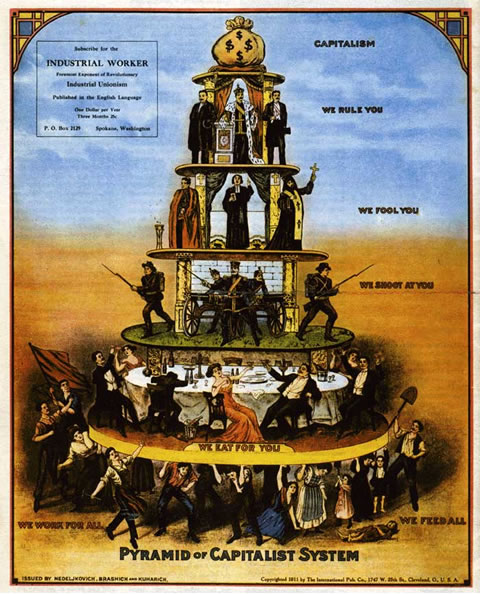
pyramid-of-capitalist-systemShortest:

Religion is the sigh of the oppressed creature, the heart of a heartless world, just as it is the spirit of a spiritless situation. It is the opium of the people.
Karl Marx, Critique of Hegel's Philosophy of Right
German economist & Communist political philosopher (1818 - 1883)


In context:

Religious distress is at the same time the expression of real distress and the protest against real distress. Religion is the sigh of the oppressed creature, the heart of a heartless world, just as it is the spirit of a spiritless situation. It is the opium of the people. The abolition of religion as the illusory happiness of the people is required for their real happiness. The demand to give up the illusion about its condition is the demand to give up a condition which needs illusions.
Karl Marx, Critique of Hegel’s Philosophy of Right


From atheism.about.com:

In the above quotation Marx is saying that religion’s purpose is to create illusory fantasies for the poor. Economic realities prevent them from finding true happiness in this life, so religion tells them that this is OK because they will find true happiness in the next life. Although this is a criticism of religion, Marx is not without sympathy: people are in distress and religion provides solace, just as people who are physically injured receive relief from opiate-based drugs.

The quote is not, then, as negative as most portray (at least about religion). In some ways, even the slightly extended quote which people might see is a bit dishonest because saying “Religion is the sigh of the oppressed creature...” deliberately leaves out the additional statement that it is also the “heart of a heartless world.”

What we have is a critique of society that has become heartless rather than of religion which tries to provide a bit of solace. One can argue that Marx offers a partial validation of religion in that it tries to become the heart of a heartless world. For all its problems, religion doesn’t matter so much — it is not the real problem. Religion is a set of ideas, and ideas are expressions of material realities. Religion is a symptom of a disease, not the disease itself.

Still, it would be a mistake to think that Marx is uncritical towards religion — it may try to provide heart, but it fails. For Marx, the problem lies in the obvious fact that an opiate drug fails to fix a physical injury — it merely helps you forget pain and suffering. This may be fine up to a point, but only as long as you are also trying to solve the underlying problems causing the pain. Similarly, religion does not fix the underlying causes of people’s pain and suffering — instead, it helps them forget why they are suffering and gets them to look forward to an imaginary future when the pain will cease.


Maybe that's why we can't change the minds of the fundamentalists: we can't offer them a better drug, Our social issues of Poverty, Ignorance and Injustice are still with us. It's the height of irony that religion imposes its own injustices on so many...

Until we create a reality that is more attractive to them than the one they exist in now, they will remain addicted to the false promise of an afterlife.

(Click here to see a larger image and feel the "luuuvv"!)

(First posted at God is for Suckers!)